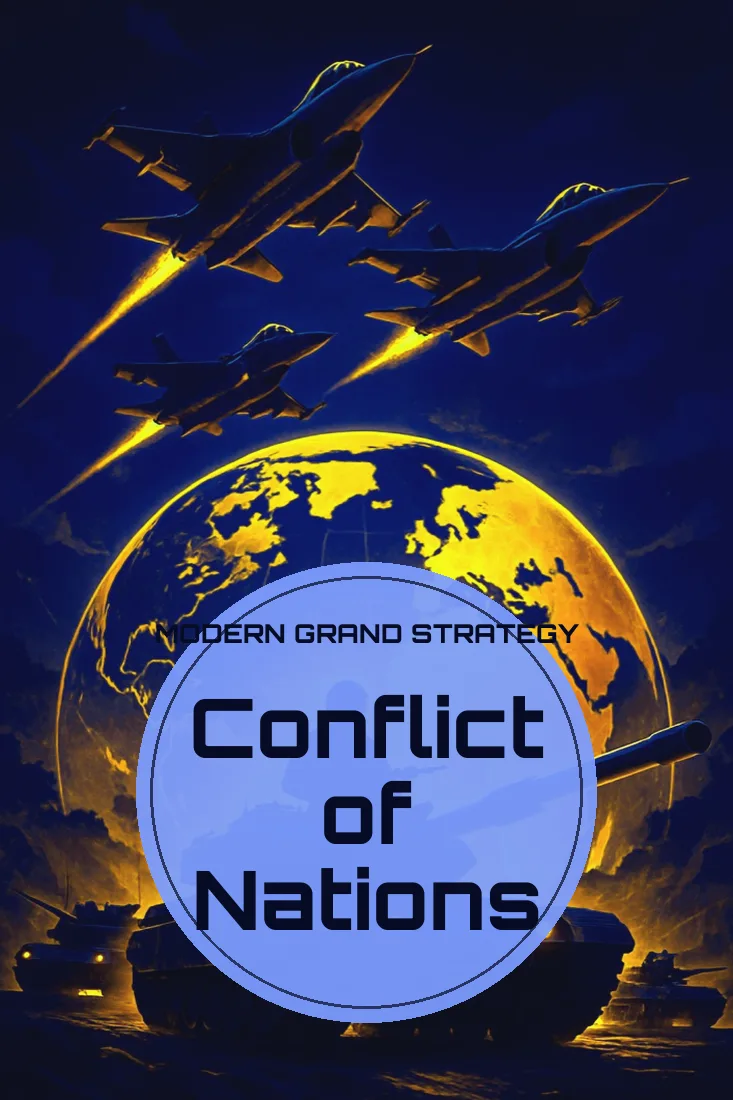
Conflict of Nations is the game our editors describe with the most enthusiasm and the most sighs. It takes the real-time, province-and-city structure of its Second World War and Great War cousins and drops it into a present-day world war on a map of the whole globe. The arsenal is enormous, the map is huge and the campaign can run for weeks against dozens of other nations.
The game also goes by Supremacy: World War 3 on its publisher’s portfolio, which tells you where it sits in the family. If Call of War is the teacher and Supremacy 1914 the diplomat, Conflict of Nations is the general staff exam. We loved it most in rounds where our coalition was organized and least in rounds where it wasn’t.
Cities, resources and a market that rewards sharp eyes
Your economy is built on cities, each producing a share of several resources, with particular territories producing more of a given one. You can expand local industry, but you can also trade on the market, and this is where Conflict of Nations first separates itself. Selling surplus at the right moment and buying what your research needs turns a mediocre starting position into a competitive one.
Morale is the other pillar. It drives productivity and the risk of unrest, and we came to think of it the way one reviewer did, as the stat that quietly governs everything. Overextend, fight on too many fronts or leave conquered cities unattended, and the numbers start to sag. A modern war, the game argues, is lost at home as often as on the front.
From infantry to stealth bombers, one research step at a time
Research is the spine of every campaign. Units range from infantry and armour to helicopters, submarines, stealth bombers and missiles, with strategic weapons sitting far up the tree. In some scenarios a nation’s research track follows an Eastern, Western or European pattern, which gives different countries different hardware and quietly shapes how they fight.
Because the toolbox is so large, specialization matters more than in any other game here. We tried to research a little of everything in our first round and fielded a mediocre army in every domain. In the second, we committed to air defence and naval power and held a coastline against a much larger rival. The lesson stuck: pick a doctrine of your own, even when the game does not force one on you.
Coalitions are how anyone actually wins
Victory in Conflict of Nations is measured in points, and the first side to reach the target takes the round. Points come from holding territory, which means that on a map this size, no single player can be everywhere at once. Coalitions are the answer, and the best ones run like small headquarters: someone watches the air picture, someone manages trade, someone plans the next offensive.
The diplomatic tools themselves are plain — largely messaging between players — so the quality of a coalition depends entirely on the people in it. Our strongest round came from a group spread from Atlantic Canada to British Columbia that agreed a rota on day two. Our weakest came from a coalition of strangers who never spoke after the first evening.
The weight of it all
Conflict of Nations is the most demanding game on this site. Actions take real time — moving troops, building, recruiting — so a plan needs to be set hours in advance, yet the number of systems means there is always something to adjust. During a hot war we found ourselves checking in five times a day, and missing a session hurt more than in Call of War.
It is also the game where paid acceleration bites hardest. Instant morale recovery and speed-ups are available to those who pay, and in a close contest that is decisive, which is why fairness scores lowest here among the four map-wide games. A disciplined coalition of free players remains competitive, but solo free play against a determined spender is an uphill march.
Orders for your first seven days in Conflict of Nations
- Pick a nation with few land borders and a coastline you can defend, then study which resources your cities produce most.
- Commit early to two research priorities, ideally air defence plus one striking arm, rather than spreading across every branch.
- Watch the market each day and trade your surplus for what your research queue needs next.
- Keep morale high by fighting one war at a time and garrisoning every captured city before marching on.
- Join an active coalition by midweek and agree who watches the map at which hours.
Where it chafes
- Paid speed-ups and morale recovery weigh heavily in close contests.
- The learning curve is steep, with thin explanations for many systems.
- Active wars demand more daily check-ins than most schedules comfortably allow.
Ground it holds well
- The deepest and most varied modern arsenal of any browser strategy game we have played.
- The market turns economics into a real skill rather than a background timer.
- Region-flavoured research tracks make nations feel distinct in some scenarios.
- Well-organized coalitions produce the most satisfying team play on the site.
Who should sign up for Conflict of Nations
Experienced strategy players and ambitious newcomers who want a modern war with every tool on the table, and who have either a reliable coalition or a lot of spare minutes. If you finished a Call of War round and wanted more systems, more hardware and more map, this is the next step.
Final dispatch on Conflict of Nations
Conflict of Nations is the deepest game on our list and the hungriest. Its modern arsenal, market economy and global map make for genuinely gripping campaigns, especially inside a well-run coalition. It asks more of your day than its siblings and lets paying rivals push harder, so it lands third rather than first. Go in prepared, with friends, and it will reward you.