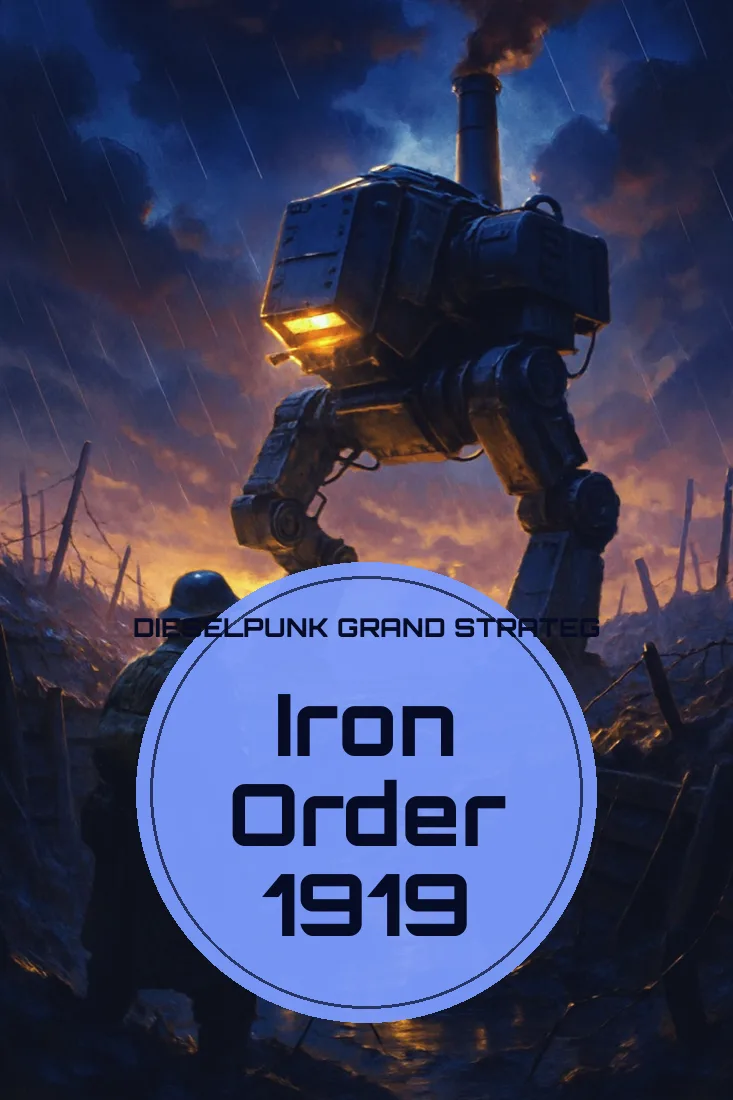
Iron Order 1919 starts from a simple what-if: the Great War kept going, and the factories of Europe kept inventing. By 1919 the trenches are crossed by armoured Mechs, and the biggest of them, the Titans, are slowly taking over the business of war. Its weaponry borrows openly from diesel-punk, tesla-punk and steampunk ideas, and the art leans into it with rivets and smokestacks.
Under that costume is a familiar Bytro skeleton: real-time matches on maps drawn from First World War scenarios and beyond, nations split into provinces with their own properties, and a goal of holding most of the map. Matches can host up to 101 players. The game reached Steam and the Microsoft Store in 2022 after starting life as Bytro’s first mobile title, and it still feels comfortable on a phone.
Every unit type has a Titan waiting at the top
The headline mechanic is the Titan. Every unit type in Iron Order 1919 has a special Titan class with unusual power or utility, which means each branch of your army builds toward a showpiece machine. Planning a match becomes a question of which Titan you want to field and when, and how much of your economy you can spare to get there without leaving your borders bare.
In practice, Titans change the emotional shape of a war. A Titan advancing on your border is a genuine event, the kind that sends a coalition chat into a flurry of plans. We found that the best answer was rarely a Titan of our own; it was usually cheaper units in the right place, supported by research that targeted the threat. That push and pull keeps the spectacle grounded in strategy.
Provinces, research and a slow economic grind
Strip away the Mechs and Iron Order 1919 is a careful economic game. Provinces have distinct properties, and building up the right ones matters more than grabbing as many as possible. Research opens new machines and improvements over the course of a match, and as in the other Bytro titles, it costs time as well as resources, so early choices echo for days.
The economy is less fussy than in Supremacy 1914, which we count as a mild positive for newcomers and a mild negative for veterans. You will rarely be crushed by a morale spiral here, but you will also miss some of the tension that makes the older game so rich. It sits comfortably in the middle: deep enough to reward planning, forgiving enough to learn on the job.
Treaties, trade and calculated betrayal
From the tutorial onward, Iron Order 1919 puts diplomacy on the table. Treaties, diplomatic relations and economic agreements give coalitions real substance, and the game’s pitch openly invites you to trade with neighbours and betray them when the moment is right. With up to a hundred other players on a map, someone always is.
The coalition play is solid rather than spectacular. The tools work, alliances form quickly and the in-game social side is lively, but because the war machines draw so much attention, conversations tilt toward who is building which Titan rather than toward long-term political arrangements. It is a more military diplomacy than Supremacy 1914’s, and some of our editors preferred it for exactly that reason.
Where the iron creaks
Iron Order 1919 is no longer featured in its publisher’s main portfolio site, although its own site and app store pages remain live and updated. That makes us a little cautious about its long-term future, and it is one reason we rank it below the three bigger siblings. Rounds we joined were still active, but we found fewer of them on the go at any one time.
The fantasy setting also cuts both ways. Readers drawn to history for its own sake can find the Mechs distracting, and some unit matchups feel less intuitive than tank-versus-anti-tank in Call of War. Paid acceleration exists here as elsewhere and is felt mostly in the race toward the first Titans. None of this spoils the game, but it keeps it in the middle of our table.
Orders for your first seven days in Iron Order 1919
- Read your provinces’ properties before building anything and invest first where the bonuses stack best.
- Choose one unit line and plan the research path toward its Titan, rather than chasing every machine at once.
- Open talks with every neighbour, offering trade before threats, and note who replies quickly.
- Keep cheap counters to enemy Titans in reserve near your border instead of matching machine for machine.
- Settle into a coalition by the weekend and agree who answers alarms during your working hours.
Where it chafes
- Fewer active rounds than the bigger Bytro titles at any given moment.
- Diplomacy tilts toward machine talk rather than long political games.
- Its absence from the publisher’s main portfolio site raises questions about its future.
Ground it holds well
- Titans give every army a goal and every match a few unforgettable moments.
- The economy is forgiving enough for newcomers yet still rewards careful province building.
- Diesel-punk art and machinery give the Great War map a fresh, playful identity.
- It plays comfortably on a phone, reflecting its mobile-first origins.
Who should sign up for Iron Order 1919
Players who like grand strategy but want a dash of spectacle, and anyone who finished a Supremacy 1914 round wishing the tanks were taller. It also suits commuters who prefer a phone to a laptop, since the game began life on mobile and still feels at home there.
Final dispatch on Iron Order 1919
Iron Order 1919 takes the Great War somewhere strange and mostly makes it work. Titans give every army a goal, the province economy keeps it honest and the diplomacy is lively enough. It is a little shallower and a little quieter than its siblings, with a slightly uncertain future, so it sits fourth. For history buffs with a taste for walking iron, it is a fine change of front.